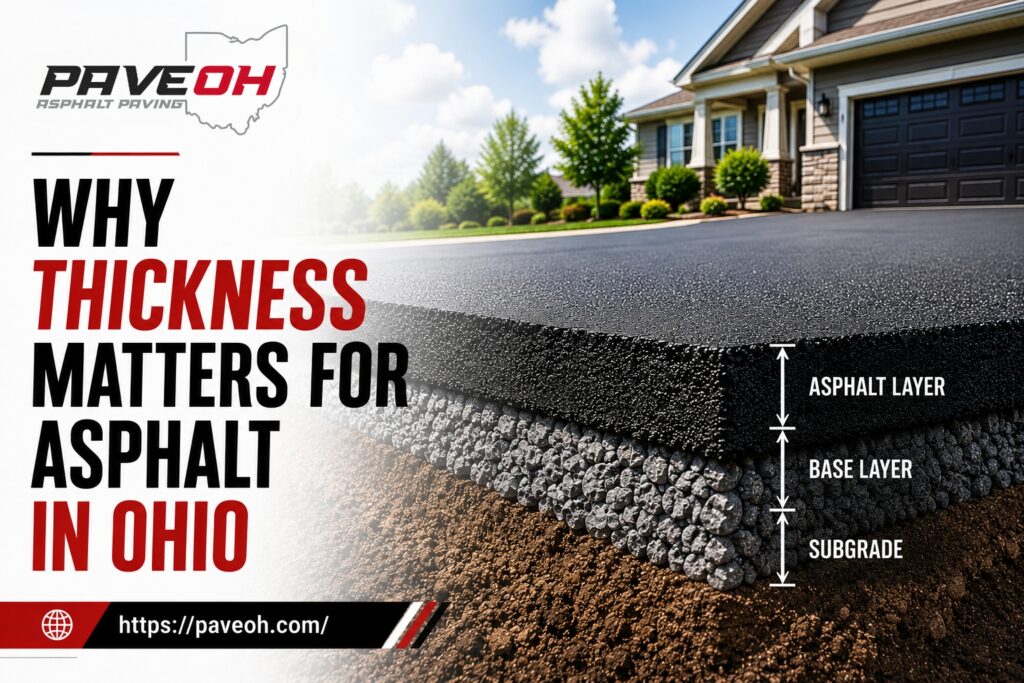
Can a few extra inches of asphalt really make a difference? Absolutely. One of the biggest factors affecting the lifespan of any driveway, parking lot, or commercial pavement is asphalt thickness. While a newly paved surface may look smooth regardless of depth, what’s beneath the surface determines whether it will last for decades or begin cracking, rutting, and deteriorating much sooner. In Ohio, where pavements experience freezing winters, heavy rainfall, and repeated traffic loads, selecting the proper asphalt thickness is one of the most important decisions during any paving project.
If you’re researching asphalt thickness Ohio, it’s important to understand that there is no one-size-fits-all solution. The appropriate thickness depends on the intended use, traffic volume, soil conditions, drainage, and the strength of the base beneath the asphalt. Pave OH explains that every project begins with evaluating the soil, drainage, and layout to determine the correct base construction and asphalt thickness before paving begins.
Why Asphalt Thickness Is So Important
Many property owners focus on the appearance of new asphalt, but the real strength of pavement comes from its structure.
Thickness directly influences:
- Load-bearing capacity
- Resistance to cracking
- Protection against rutting
- Pavement flexibility
- Long-term durability
- Overall service life
Even premium asphalt materials cannot compensate for pavement that is too thin for its intended use.
Pave OH notes that successful asphalt paving depends on material strength, weather resistance, proper drainage, and constructing pavement that performs under Ohio’s freeze-thaw cycles and traffic loads.
Ohio Weather Makes Thickness Even More Important
Ohio experiences conditions that place tremendous stress on asphalt throughout the year.
Common challenges include:
- Freezing winter temperatures
- Snow accumulation
- Freeze-thaw cycles
- Heavy spring rainfall
- Summer heat
- Moisture infiltration
- Daily vehicle traffic
When water enters pavement and freezes, it expands inside small voids. Repeated freeze-thaw cycles gradually weaken asphalt that lacks sufficient structural depth. Pave OH specifically designs projects to withstand Ohio’s temperature changes, moisture, and seasonal weather.
What Determines the Right Asphalt Thickness?
Several factors influence how thick an asphalt pavement should be.
1. Type of Property
Residential driveways generally require different pavement structures than commercial parking lots or industrial facilities.
For example:
- Homes primarily support passenger vehicles.
- Retail centers handle continuous customer traffic.
- Warehouses experience delivery trucks.
- Industrial sites carry heavier equipment.
Pave OH states that driveway thickness is selected according to expected vehicle loads, with heavier traffic requiring thicker asphalt layers than standard residential use.
2. Traffic Volume
Traffic isn’t simply about the number of vehicles.
Contractors evaluate:
- Vehicle weight
- Turning movements
- Parking duration
- Frequency of use
- Delivery vehicles
- Emergency vehicle access
The heavier and more frequent the traffic, the stronger the pavement structure must be.
3. Base Construction
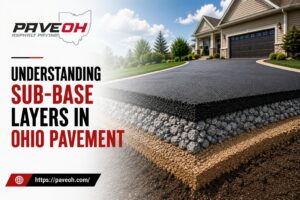
Even thick asphalt performs poorly if installed over a weak foundation.
The supporting base must be:
- Properly graded
- Well compacted
- Stable
- Adequately drained
Pave OH emphasizes that every estimate includes grading, compaction, base preparation, drainage evaluation, and appropriate asphalt thickness because the base is essential for long-term pavement performance.
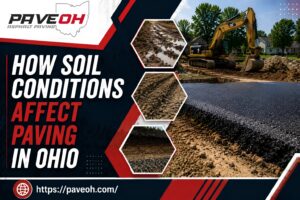
4. Soil Conditions
Ohio contains many different soil types.
Some retain moisture while others drain efficiently.
Weak or unstable soil may require:
- Additional excavation
- Thicker aggregate base
- Improved drainage
- Increased pavement support
Pave OH evaluates soil conditions before determining the proper pavement structure for each project.
How Proper Thickness Improves Pavement Performance
Greater Structural Strength
Thicker asphalt distributes vehicle loads more evenly across the base below.
Instead of concentrating stress in one location, the pavement shares the load across a larger area.
Benefits include:
- Reduced cracking
- Less deformation
- Better stability
- Longer pavement life
Better Resistance to Rutting
Rutting occurs when repeated traffic creates depressions in wheel paths.
Proper asphalt thickness helps pavement resist this permanent deformation.
Combined with proper compaction and a stable base, adequate thickness significantly improves resistance to heavy traffic.
Improved Crack Resistance
Ohio’s freeze-thaw cycles create constant expansion and contraction.
Adequate pavement thickness helps asphalt absorb these stresses more effectively than thinner pavement.
This reduces:
- Surface cracking
- Fatigue cracking
- Structural cracking
- Premature pavement failure
Longer Pavement Life
Well-designed pavement structures simply last longer.
When the correct thickness is combined with:
- Proper drainage
- Quality materials
- Good compaction
- Routine maintenance
property owners enjoy years of reliable performance before major rehabilitation becomes necessary.
Common Problems Caused by Thin Asphalt
Choosing insufficient pavement thickness often leads to early deterioration.
Common problems include:
Surface Cracking
Thin asphalt flexes more under traffic.
Over time, this repeated movement creates visible cracks.
Potholes
Once cracks allow water underneath, weakened pavement begins breaking apart.
Potholes frequently develop when pavement lacks adequate structural support.
Rutting
Heavy vehicles gradually compress thinner asphalt layers.
Wheel paths become visible, collecting water and accelerating deterioration.
Edge Failure
Thin pavement edges receive less support.
Over time they may crumble, separate, or collapse.
Shortened Service Life
The biggest consequence of inadequate thickness is premature replacement.
While thinner pavement may initially appear similar, it often requires repairs much sooner than properly designed pavement.
Factors Contractors Evaluate Before Choosing Thickness
Professional paving contractors don’t simply estimate asphalt depth.
Instead, they evaluate the complete project.
| Evaluation Factor | Why It Matters |
|---|---|
| Soil Conditions | Determines foundation strength |
| Drainage | Prevents water damage |
| Base Material | Supports asphalt layers |
| Vehicle Weight | Determines structural requirements |
| Property Use | Residential vs. commercial needs |
| Existing Pavement | Influences overlay or replacement decisions |
| Grading | Ensures proper water runoff |
Pave OH explains that every estimate includes evaluation of drainage, base preparation, grading, asphalt mix selection, and pavement thickness before construction begins.
Thickness Is Only Part of the Equation
Many property owners assume thicker asphalt automatically guarantees better pavement.
In reality, thickness works together with several equally important factors.
These include:
- Proper excavation
- Base compaction
- Drainage design
- Asphalt mix quality
- Installation techniques
- Final compaction
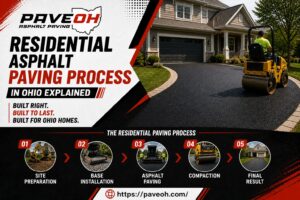
Pave OH notes that its installation process begins with evaluating soil, drainage, and layout before grading, compacting the foundation, placing hot-mix asphalt, and compacting each layer to create a smooth, durable surface.
Why Professional Installation Matters
Proper asphalt thickness only delivers results when installed correctly.
Experienced paving contractors understand:
- Load requirements
- Soil conditions
- Drainage design
- Pavement engineering
- Material selection
- Compaction methods
Pave OH states that it brings over 25 years of industry experience, premium materials, and precision craftsmanship to residential and commercial paving projects throughout Columbus and Central Ohio.
Why Choose Pave OH?
At Pave OH, every paving project begins with a detailed site evaluation.
Rather than applying the same pavement structure everywhere, the team considers:
- Property use
- Traffic volume
- Drainage
- Soil conditions
- Base preparation
- Required asphalt thickness
Pave OH offers:
- Residential asphalt paving
- Commercial paving
- Driveway replacement
- Parking lot construction
- Asphalt resurfacing
- Asphalt repair
- Milling and paving
- Private road paving
- Parking lot striping
The company emphasizes customized paving solutions built to withstand Ohio’s freeze-thaw cycles, traffic loads, and seasonal weather while delivering durable, long-lasting results.
Final Thoughts
When it comes to asphalt thickness Ohio, appearances can be misleading. Two newly paved driveways may look nearly identical, yet the one built with the correct pavement structure, proper base preparation, and suitable asphalt thickness is far more likely to withstand Ohio’s challenging weather and daily traffic for years to come.
Thickness is not simply about adding more asphalt—it’s about designing a pavement system that matches the property’s specific needs. Combined with proper grading, drainage, compaction, and quality materials, the right asphalt thickness helps reduce cracking, resist rutting, support heavier loads, and maximize pavement lifespan.
If you’re planning a new driveway, parking lot, or resurfacing project, Pave OH provides expert evaluations, customized pavement designs, and professional installation throughout Columbus and Central Ohio. With more than 25 years of experience, premium materials, and a focus on long-term performance, Pave OH delivers asphalt surfaces built to perform in Ohio’s demanding climate.