What should homeowners consider before replacing an old asphalt driveway in Central Ohio? Is the condition of the existing pavement the only thing that matters, or can soil conditions, drainage, excavation, and driveway design also influence the overall project?
A residential driveway goes through a lot throughout the year. Daily vehicle traffic, heavy rainfall, road salt, and Ohio’s changing temperatures gradually affect the asphalt surface. Over time, small cracks can become larger problems, potholes may develop, and sections of the driveway can begin to sink or deteriorate.
When these problems become widespread, replacing the existing driveway may be a more practical solution than continuing with temporary repairs. However, every replacement project is different. The work involved depends on the driveway’s size, existing pavement condition, foundation, drainage, and the requirements of the property.
For homeowners planning Driveway Replacement in Columbus Ohio, understanding these factors can make the decision-making process easier. It also helps set realistic expectations about the work required before a new asphalt surface can be installed.
At Pave OH, we believe that a successful driveway project starts with a proper site evaluation and an honest recommendation. Let’s look at the main factors that influence residential driveway replacement in Central Ohio.
Why Driveway Replacement Requirements Differ from One Property to Another
Not every driveway has the same construction history or ground conditions. Some properties have a relatively stable stone base beneath aging asphalt, while others have deeper problems caused by poor drainage, soil movement, or years of deterioration.
These differences determine how much preparation is necessary before installing new pavement.
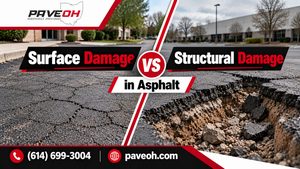
For example, a driveway with surface-level damage may be suitable for resurfacing. On the other hand, widespread cracking, sinking areas, and recurring potholes may indicate that the underlying base has deteriorated.
This distinction is important because installing fresh asphalt without addressing structural problems can lead to similar damage appearing again.
Pave OH evaluates the existing pavement, drainage, slope, and base conditions before recommending whether repair, resurfacing, or full replacement is the right approach.
1. Driveway Size and Total Surface Area
The size of a driveway is one of the first things considered when planning a replacement project. A larger paved area generally requires more asphalt, additional preparation, and greater installation coverage.
However, square footage alone does not determine the amount of work involved. The driveway’s shape and layout can also affect the project.
Some important considerations include:
- Overall dimensions: The total length and width determine the amount of surface that needs to be prepared and paved.
- Driveway layout: Curved driveways, irregular shapes, and multiple sections may require additional planning.
- Parking areas: Extra parking spaces or wider entrances increase the area involved.
- Garage connections: Transitions between the driveway and garage entrance need proper grading and finishing.
- Property access: Limited working space may influence equipment movement and site preparation.
A proper measurement helps establish the actual scope of the project. During an on-site evaluation, Pave OH considers the driveway’s dimensions and layout to determine the appropriate installation requirements.
2. Existing Asphalt Condition and Structural Damage
The condition of the existing driveway is another major factor.
An asphalt surface may look worn because of weather exposure, but visible deterioration can sometimes indicate deeper structural problems. Understanding the difference helps homeowners avoid choosing a solution that only addresses the appearance of the pavement.
Common signs that a driveway may need more extensive work include:
- Widespread interconnected cracks
- Large or recurring potholes
- Sunken or uneven pavement sections
- Crumbling edges
- Water collecting in low areas
- Repeated failure of previously repaired sections
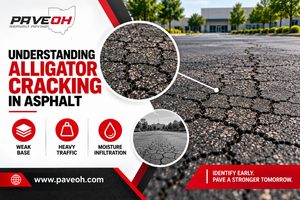
For example, isolated cracks may be addressed through appropriate maintenance. However, extensive alligator cracking often indicates that the pavement foundation has weakened.
When the damage extends into the base, simply covering the surface with another asphalt layer may not provide a lasting solution.
This is why Pave OH considers both visible pavement damage and underlying conditions before recommending a replacement.
3. Old Asphalt Removal and Excavation
Removing the existing pavement is an important part of many driveway replacement projects.
The amount of removal and excavation depends on how the old driveway was constructed and whether the materials underneath remain suitable for supporting new asphalt.
In some cases, removing the existing asphalt is sufficient. In others, sections of the underlying stone base or unstable soil may also need attention.
The following conditions can influence the removal process:
- Multiple layers of deteriorated asphalt
- Weak or damaged base materials
- Soft spots beneath the existing pavement
- Areas affected by water infiltration
- Uneven sections caused by settlement
- Existing pavement that has lost structural stability
Proper removal allows the paving team to identify problems that might otherwise remain hidden beneath the old surface.
Pave OH includes removal and excavation where required as part of its driveway replacement process. The objective is to prepare a stable foundation rather than install new asphalt over materials that may cause future problems.
4. Soil Conditions and Stone Base Preparation
What happens beneath the asphalt is just as important as the surface itself.
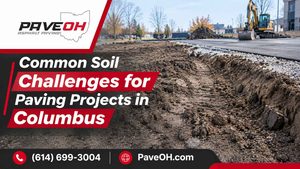
Central Ohio has varying soil conditions, and clay-heavy soils in particular can retain moisture. When water accumulates beneath a driveway, the supporting ground may become unstable, contributing to settlement, cracks, and pavement failure.
This makes proper base preparation especially important for residential paving projects.
Several factors need to be considered:
Soil stability: The existing ground must be suitable to support the driveway structure and expected vehicle traffic.
Existing base condition: The stone foundation needs to be evaluated for weakness, movement, and deterioration.
Excavation depth: The required preparation depends on the condition of the existing materials and the intended pavement structure.
Stone base installation: Appropriate crushed stone provides a stable foundation for the asphalt.
Compaction: Proper compaction helps create a firm and consistent supporting layer.
For homeowners considering Residential Asphalt Paving in Columbus Ohio, base preparation should be an essential part of the project discussion.
A smooth surface may look impressive immediately after installation, but its performance depends heavily on the foundation beneath it.
Pave OH focuses on grading, base preparation, and compaction to help create a driveway that can handle everyday use and local environmental conditions.
5. Drainage and Proper Grading
Water is one of the major factors that can affect asphalt pavement in Central Ohio.
Heavy rainfall, melting snow, and poor drainage can allow moisture to collect around or beneath a driveway. Over time, this can weaken the supporting base and contribute to cracking, potholes, and uneven pavement.
That is why drainage needs to be considered during driveway replacement rather than treated as an afterthought.
Important drainage considerations include:
- Driveway slope: The surface needs an appropriate grade to direct water away.
- Low spots: Depressions can collect standing water and accelerate pavement deterioration.
- Garage transitions: The connection between the driveway and garage should be properly graded.
- Surrounding landscape: Nearby lawns, structures, and paved areas can influence water movement.
- Existing drainage problems: Recurring water accumulation may require additional site preparation.
Correct grading helps water move away from the pavement instead of collecting on its surface.
Pave OH evaluates drainage and slope during the site visit and incorporates the necessary grading work into the replacement plan.
6. Asphalt Quality and Pavement Thickness
The asphalt selected for a driveway also plays an important role in its performance.
Different residential properties have different usage requirements. A driveway used mainly for passenger vehicles may have different needs from one that regularly accommodates heavier vehicles or multiple parking spaces.
Several considerations influence material selection and installation:
- Asphalt mix suitability
- Expected vehicle traffic
- Required pavement thickness
- Existing base conditions
- Proper asphalt placement and compaction
The pavement structure should match the driveway’s intended use rather than follow the same specification for every property.
Pave OH uses hot-mix asphalt and considers traffic requirements and site conditions when determining the appropriate installation approach.
Proper compaction is equally important. It helps create a dense, consistent surface that can withstand regular vehicle use.
7. Driveway Design, Widening, and Additional Features
A driveway replacement project can also be an opportunity to improve the property’s existing layout.
Some homeowners prefer to maintain their current driveway dimensions, while others may want additional parking space or a wider entrance.
These changes can affect the overall scope of work because they may require additional excavation, grading, base preparation, and asphalt installation.
Possible improvements include:
- Widening an existing driveway
- Extending the paved parking area
- Improving the entrance near the road
- Creating additional parking spaces
- Adjusting transitions around the garage
- Adding decorative paver stone borders
These features should be discussed during the initial planning stage. Doing so helps ensure that the finished driveway meets the homeowner’s functional and aesthetic expectations.
Pave OH also offers paver stone options for homeowners interested in improving the appearance of outdoor spaces alongside their asphalt driveway.
8. Site Accessibility and Equipment Requirements
The physical layout of a property can influence how smoothly a driveway replacement project progresses.
Open access makes it easier for equipment and materials to reach the work area. However, narrow entrances, landscaping, nearby structures, and limited working space can require additional planning.
Before construction begins, it is important to evaluate:
- Access for paving equipment
- Space for removing old asphalt
- Nearby landscaping and structures
- Available working areas
- Connections to existing paved surfaces
Planning these details helps the paving crew organize the work and minimize unnecessary disruption to the property.
At Pave OH, site accessibility is considered during project evaluation so that the preparation and installation process can be planned appropriately.
9. Weather and Seasonal Conditions in Central Ohio
Ohio’s seasonal weather has a direct influence on asphalt paving.
Cold temperatures, rainfall, snow, and freeze-thaw cycles can affect both existing pavement and new installation work.
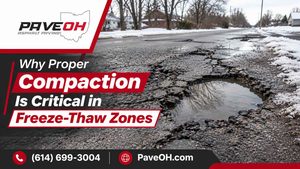
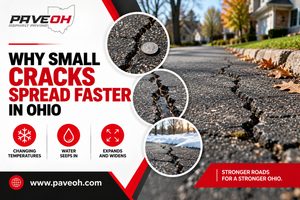
During winter, moisture can enter small cracks and freeze as temperatures drop. Repeated freezing and thawing can gradually widen those cracks and contribute to pavement deterioration.
For new asphalt installation, suitable weather and ground conditions are important for achieving proper placement and compaction.
Homeowners should keep a few seasonal considerations in mind:
- Spring: A good opportunity to inspect winter damage and plan necessary driveway improvements.
- Summer: Warmer conditions can provide suitable paving opportunities when the site is ready.
- Fall: Another potential installation period, depending on temperatures and weather conditions.
- Winter: Freezing temperatures and snow can limit conventional hot-mix asphalt paving work.
Rather than choosing an installation date based only on convenience, homeowners should consider the condition of the site and the weather requirements for proper paving.
Pave OH plans projects around suitable installation conditions to help maintain workmanship and pavement quality.
10. Choosing Between Repair, Resurfacing, and Full Replacement
One of the most important decisions for homeowners is determining whether a driveway actually needs complete replacement.
Not every damaged asphalt surface requires reconstruction. In some situations, repair or resurfacing may be a more suitable option.
Understanding the differences helps prevent unnecessary work.
| Existing driveway condition | Suitable service to consider | Main objective |
|---|---|---|
| Small isolated cracks | Asphalt maintenance or repair | Address localized damage |
| Individual potholes | Asphalt driveway repair | Restore damaged sections |
| Worn surface with a stable base | Asphalt resurfacing | Renew the existing pavement surface |
| Widespread structural cracking | Full driveway replacement | Rebuild the pavement structure |
| Sinking areas and base failure | Excavation and replacement | Correct underlying instability |
Homeowners searching for Asphalt Driveway Repair in Columbus Ohio should first determine whether the damage is limited to the surface or extends into the foundation.
Similarly, Asphalt Resurfacing in Columbus Ohio may be appropriate when the existing base remains stable and the pavement is suitable for an overlay.
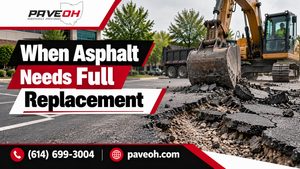
However, resurfacing cannot correct a severely deteriorated foundation. When the base has failed, a complete replacement may be necessary.
Pave OH provides repair, resurfacing, and replacement solutions and recommends the option that best fits the actual driveway condition.
Key Factors to Evaluate Before Replacing Your Driveway
Before moving forward with a residential driveway replacement, homeowners should understand how the different project requirements work together.
| Factor | What to evaluate | Why it matters |
|---|---|---|
| Driveway dimensions | Length, width, shape, and layout | Establishes the project scope |
| Existing pavement | Cracks, potholes, and settlement | Determines the level of restoration needed |
| Asphalt removal | Existing pavement and damaged sections | Identifies removal and excavation requirements |
| Soil and base | Ground stability and stone foundation | Provides structural support |
| Drainage | Slope and water movement | Helps prevent moisture-related deterioration |
| Asphalt selection | Mix suitability and thickness | Matches pavement to intended use |
| Additional features | Extensions and parking areas | Influences preparation and installation |
| Site accessibility | Equipment access and working space | Helps organize construction |
| Weather | Temperature and ground conditions | Supports proper asphalt installation |
A professional site evaluation helps bring all these considerations together and provides a clearer understanding of what the property actually needs.
How Pave OH Helps Homeowners Through the Replacement Process
At Pave OH, we understand that replacing a residential driveway is more than a construction project. Homeowners want clear recommendations, dependable workmanship, and confidence that the work is being handled properly.
That is why our process focuses on communication and careful preparation from the beginning.
1. On-Site Inspection and Evaluation
We start by visiting the property, measuring the driveway, and examining the existing pavement, base, slope, and drainage conditions.
This allows us to identify potential problems and understand the actual requirements of the project.
2. Honest Recommendations and Project Planning
After evaluating the driveway, we explain the available options. If a repair or resurfacing can address the problem, we do not automatically recommend full replacement.
Our goal is to provide a practical solution based on the property’s condition.
3. Removal and Site Preparation
When replacement is necessary, we remove the old asphalt and excavate unstable materials where required.
We then prepare the foundation to support the new pavement.
4. Grading and Base Installation
We establish the appropriate slope for drainage and install and compact the necessary crushed stone base.
This stage is essential for creating a stable foundation.
5. Asphalt Installation and Compaction
Our team installs hot-mix asphalt according to the driveway’s intended use and site requirements. Proper compaction helps achieve a smooth and consistent finish.
6. Final Inspection and Aftercare Guidance
Once installation is complete, we focus on clean edges, proper transitions, site cleanup, and the overall finished appearance.
We also explain how long homeowners should wait before using the new surface and provide practical maintenance guidance for caring for the driveway.
Throughout the process, our team aims to keep homeowners informed and make the experience as straightforward as possible.
Why Homeowners Choose Pave OH for Residential Paving
Choosing the right paving company is an important part of a successful driveway replacement.
Pave OH has been serving homeowners and property owners in Central Ohio since 2000. With more than 25 years of industry experience, our team understands the local conditions that influence asphalt performance.
Here are some important aspects of our approach:
- Local experience: We understand the effects of Central Ohio’s freeze-thaw cycles, rainfall, and soil conditions.
- Complete project preparation: We focus on excavation, grading, drainage, and base preparation before paving.
- Practical recommendations: We consider repair, resurfacing, and replacement based on the actual condition of the driveway.
- Clear communication: We explain the recommended work and keep homeowners informed throughout the project.
- Professional workmanship: We pay attention to material selection, asphalt placement, compaction, and finishing.
- Customer-focused support: We provide aftercare recommendations and help homeowners understand how to maintain their new pavement.
We believe that a well-planned driveway replacement should address the underlying problems, not simply make the surface look new.
Final Thoughts
Replacing a residential asphalt driveway in Central Ohio involves several important considerations. Driveway size, existing pavement damage, excavation, soil conditions, drainage, asphalt selection, and weather all influence the work required to achieve a reliable result.
Understanding these factors before construction begins helps homeowners make better decisions and avoid overlooking essential preparation work.
Whether your driveway has widespread cracks, recurring potholes, poor drainage, or significant structural deterioration, the best starting point is a proper evaluation of the existing pavement.
At Pave OH, customer satisfaction is an important part of every project. We take time to understand each property’s requirements, provide honest recommendations, communicate clearly, and focus on quality workmanship throughout the installation process. Our support does not end when the asphalt is laid. We also provide aftercare guidance and help homeowners understand the maintenance steps that can protect their new driveway.
From the initial site visit to the final inspection, our goal is to make every homeowner feel informed, supported, and confident in the completed work.
Planning a residential driveway replacement in Columbus or the surrounding Central Ohio communities? Contact Pave OH today to schedule a free on-site estimate. Our team is ready to evaluate your driveway, explain the right options, and help you move forward with a paving solution that suits your property.