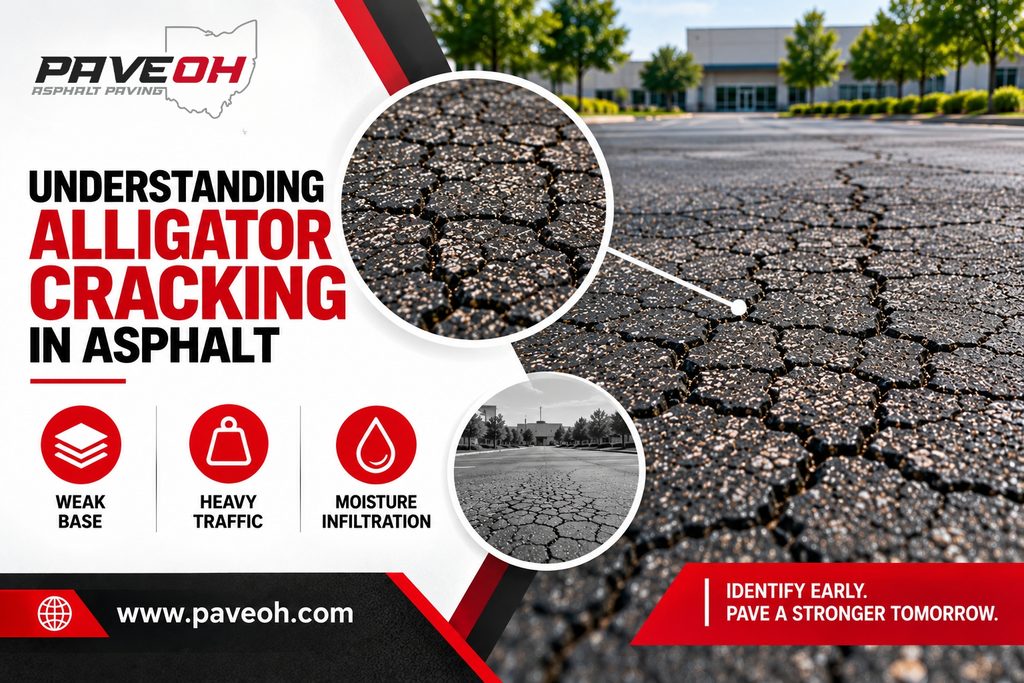
What Is Alligator Cracking in Asphalt? Have you noticed a network of interconnected cracks that resembles an alligator’s skin across an asphalt driveway or parking lot? This pattern is known as alligator cracking Ohio property owners may encounter as pavement ages or its supporting structure becomes weakened.
Unlike a single surface crack, alligator cracking generally indicates more extensive pavement distress. Pave OH explains that widespread alligator cracking can be associated with base failure and structural weakness, particularly when combined with water infiltration, poor drainage, or repeated traffic loading.
Understanding what causes this type of cracking is important because simply sealing the visible cracks may not address the underlying problem.
What Does Alligator Cracking Look Like?
Alligator cracking usually appears as interconnected cracks forming irregular blocks across the pavement surface.
The pattern may start with individual cracks and gradually become more connected. As deterioration progresses, the cracked sections can become loose, break apart, or develop potholes.
Common signs include:
- Interconnected cracking
- Small irregular pavement blocks
- Crumbling around cracked sections
- Depressions or soft areas
- Potholes developing within the cracked area
- Cracking concentrated in vehicle wheel paths
Pave OH identifies widespread alligator cracking as one of the warning signs that a pavement may require more extensive repair or replacement.
Why Does Alligator Cracking Develop?
Alligator cracking can have several contributing causes rather than one single cause.
1. Weak Base or Subbase
The layers beneath asphalt provide important structural support. If the base or subbase becomes weakened, the asphalt above can begin cracking under repeated vehicle loads.
Pave OH’s guidance on soil conditions notes that alligator cracking is commonly associated with sub-base failure, poor drainage, or repeated overloading.
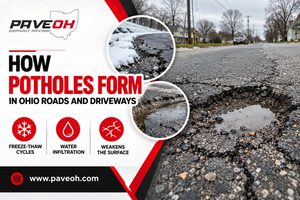
2. Water Infiltration
Water is particularly damaging when it reaches the pavement’s supporting layers.
Pave OH explains that water entering cracks can reach the base and subgrade, where it can weaken the pavement structure.
Once the supporting material loses strength, traffic can accelerate surface deterioration.
3. Poor Drainage
Drainage and pavement structure are closely connected.
When water remains trapped beneath asphalt, it can weaken supporting materials and increase the effects of freeze-thaw cycles. Pave OH’s drainage guidance specifically identifies alligator cracking as one type of pavement distress associated with poor drainage.
4. Repeated Heavy Traffic
Every vehicle places a load on the pavement.
When asphalt and its supporting layers are already weakened, repeated traffic can contribute to progressive cracking. Areas exposed to concentrated or heavier traffic may therefore deteriorate faster when underlying support is inadequate.
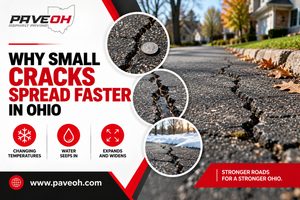
5. Freeze-Thaw Cycles
Ohio’s seasonal temperature changes can make existing pavement weaknesses more noticeable.
Water trapped within or beneath pavement can freeze and expand, then contract as temperatures rise. Repeated cycles can contribute to cracking and deterioration.
Pave OH identifies Central Ohio’s freeze-thaw cycles and fluctuating temperatures as important factors affecting asphalt performance.
How Alligator Cracking Progresses
Alligator cracking often develops gradually.
A simplified progression can look like this:
Weak pavement condition → initial cracking → interconnected cracks → weakened pavement blocks → surface deterioration → potholes and structural failure
The exact progression depends on drainage, traffic, pavement age, base conditions, and maintenance history.
This is why early pavement inspections can be useful. Pave OH’s asphalt repair process begins by assessing the severity and spread of damage before selecting a repair approach.
Is Alligator Cracking a Surface Problem?
Not necessarily.
This is one of the most important things to understand about alligator cracking.
A surface crack can sometimes be treated with an appropriate maintenance technique. But widespread alligator cracking often indicates that the pavement structure underneath is experiencing distress.
Pave OH states that interconnected cracking can signal base failure and structural weakness, meaning simple surface treatments may not be sufficient.
The pavement should therefore be evaluated as a complete system rather than judging only the visible cracks.
Can Crack Sealing Fix Alligator Cracking?
Generally, crack sealing is intended for suitable individual or working cracks rather than widespread structural failure.
Pave OH explains that professional crack sealing helps prevent water from entering cracks and can reduce the development of potholes and alligator cracks when used as preventative maintenance.
However, once extensive alligator cracking has developed, sealing the individual cracks may not correct the underlying structural problem.
The appropriate solution depends on the extent and cause of deterioration.
When Can Asphalt Repair Be Used?
Localized asphalt repair may be appropriate when damage is limited and the surrounding pavement remains structurally sound.
Pave OH offers several repair approaches, including:
- Crack sealing
- Pothole patching
- Surface patching
- Infrared repair
- Overlays
- Resurfacing
Its repair process begins with an assessment of pavement condition, drainage, base condition, and the extent of deterioration.
This evaluation helps determine whether localized repair is appropriate or whether the pavement requires a more extensive solution.
When Is Resurfacing Appropriate?
Resurfacing can restore an asphalt surface when the existing pavement remains structurally suitable.
However, a new asphalt layer does not automatically correct a failed base.
If alligator cracking is caused by significant structural problems beneath the pavement, resurfacing alone may not provide the desired long-term result.
Pave OH’s services distinguish between resurfacing suitable worn pavement and replacement when the underlying structure has failed.
When Is Full Asphalt Replacement Necessary?
Widespread alligator cracking can be one indication that full replacement needs to be considered.
Pave OH identifies the following conditions among signs that replacement may be appropriate:
- Widespread alligator cracking
- Multiple deep potholes
- Base-layer failure
- Severe drainage problems
- Extensive pavement deterioration
- Previous repairs that are no longer effective
When replacement is necessary, Pave OH’s process includes removing damaged asphalt, addressing the underlying base, correcting grading where needed, and installing new asphalt in compacted layers.
How Drainage Can Help Prevent Structural Cracking
Proper drainage is an important part of pavement longevity.
Pave OH explains that keeping the pavement base dry can reduce internal stresses and slow the development of different types of cracking, including alligator cracking.
Property owners should watch for:
- Standing water after rainfall
- Depressions
- Poor pavement slope
- Water flowing toward the pavement
- Erosion along pavement edges
- Repeated potholes in the same location
If cracking repeatedly develops in an area where water collects, drainage should be investigated as part of the repair process.
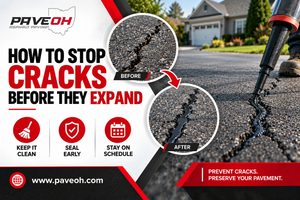
How Preventative Maintenance Helps
Alligator cracking is much more difficult to address once extensive structural deterioration has occurred.
Preventative maintenance can help protect pavement while it remains in suitable condition.
Important practices include:
Regular inspections
Identify cracks, potholes, drainage problems, and surface deterioration early.
Crack sealing
Seal appropriate cracks to reduce moisture infiltration.
Drainage maintenance
Keep water moving away from the pavement and supporting layers.
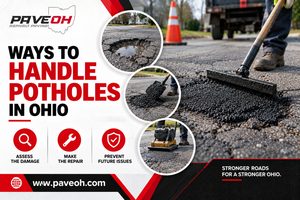
Prompt pothole repairs
Prevent localized failures from becoming larger damaged areas.
Appropriate sealcoating
Use sealcoating on suitable asphalt to protect the surface from moisture and environmental exposure.
Pave OH describes crack sealing as a preventative measure that can extend pavement life and delay more extensive repairs.
Alligator Cracking vs. Other Asphalt Cracks
| Crack Type | Typical Appearance | What It May Indicate |
|---|---|---|
| Hairline cracking | Very narrow individual lines | Early aging or surface stress |
| Longitudinal cracking | Cracks running generally parallel to pavement direction | Various surface or structural conditions |
| Transverse cracking | Cracks running across the pavement | Temperature-related movement or other stresses |
| Block cracking | Large interconnected rectangular sections | Aging and thermal movement |
| Alligator cracking | Irregular interconnected network | Potential structural or base-related distress |
The appearance alone does not provide a complete diagnosis. Pavement condition, drainage, traffic, and underlying support should also be considered.
What Should Property Owners Do About Alligator Cracking?
If you notice a small area of interconnected cracking, document its location and monitor whether it expands.
If the cracking is widespread, accompanied by potholes, or associated with sinking or drainage problems, professional evaluation becomes more important.
Pave OH’s asphalt repair service evaluates the severity and spread of pavement damage before recommending sealing, patching, milling, or another repair approach.
This helps avoid treating a structural problem as though it were only a surface crack.
Final Thoughts
Understanding alligator cracking Ohio property owners encounter is important because this cracking pattern can indicate more than ordinary surface wear. Interconnected cracks may develop when pavement has weakened because of water infiltration, poor drainage, repeated traffic loading, freeze-thaw conditions, or inadequate support beneath the asphalt. Pave OH’s guidance specifically connects widespread alligator cracking with potential base failure and structural weakness.
The appropriate response depends on the severity of the damage. Early, localized problems may be candidates for preventative maintenance or repair, while widespread structural cracking may require resurfacing or complete replacement. Pave OH evaluates pavement condition, drainage, grading, base stability, and intended use when determining an appropriate asphalt solution.
For property owners considering asphalt paving and repair in Columbus Ohio, Pave OH provides services ranging from crack sealing and patching to resurfacing and asphalt replacement. Addressing drainage and smaller pavement problems early can help reduce the conditions that allow minor deterioration to develop into more extensive structural damage.