Why do some asphalt driveways and parking lots in Ohio start cracking, sinking, or developing potholes much earlier than expected? In many cases, the issue is not the asphalt itself—it is the compaction process. Proper compaction is one of the most important parts of any paving project because it directly affects strength, durability, drainage, and long-term performance. Without it, even brand-new asphalt can begin failing far sooner than it should.
For property owners researching asphalt compaction Ohio, understanding this step is essential. Compaction is what transforms loose asphalt into a dense, stable surface capable of handling Ohio’s weather changes and daily traffic. If done correctly, it helps create a longer-lasting pavement. If rushed or done improperly, it can lead to expensive repairs much sooner.
For anyone comparing asphalt paving in Columbus Ohio, compaction is one of the biggest differences between a surface that lasts for years and one that begins showing problems after only a short time. That is why companies like Pave OH focus on every layer of the paving process rather than just the finished look.
What asphalt compaction actually means
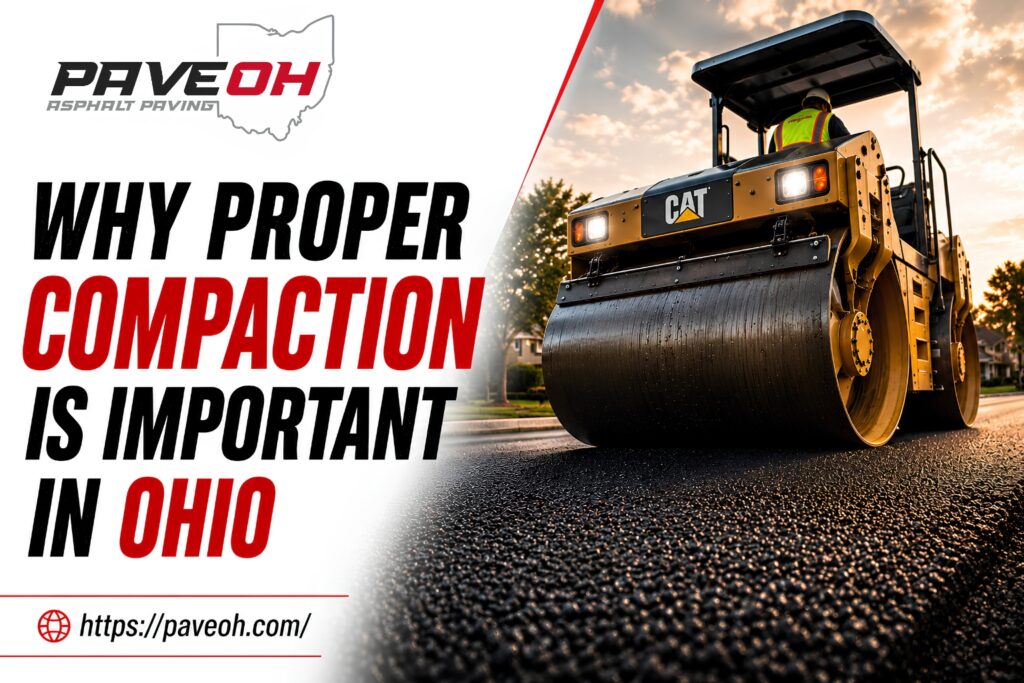
Compaction is the process of pressing and compressing asphalt after it is laid. This removes excess air voids, increases density, and helps bind the aggregate tightly together.
Fresh asphalt starts as a hot, workable mixture. But until it is compacted properly, it does not have the structural strength needed for long-term performance.
Proper compaction helps create:
- Stronger pavement structure
- Better resistance to cracking
- Improved water resistance
- Better load distribution
- Longer pavement lifespan
- Smoother surface finish
Without enough compaction, the pavement remains loose and vulnerable.
Why compaction matters so much in Ohio
Ohio weather creates unique challenges for asphalt surfaces. The constant cycle of hot summers, freezing winters, rain, snow, and ice puts heavy stress on pavement.
A properly compacted surface handles those conditions better.
Ohio-specific reasons compaction matters:
1. Freeze-thaw cycles
Ohio winters are especially hard on asphalt. Water enters weak spots, freezes, expands, and creates cracks.
When pavement is compacted properly:
- There are fewer air voids
- Less water penetrates the surface
- The base remains stronger
- Cracks form more slowly
Poor compaction allows moisture to enter more easily, increasing winter damage.
2. Heavy rainfall
Ohio gets significant rainfall throughout the year. If asphalt is too porous because of poor compaction, water can seep into the pavement and weaken the base.
This often causes:
- Soft spots
- Surface depressions
- Edge breakdown
- Potholes
Good compaction helps minimize water infiltration.
3. Traffic stress
Every vehicle adds pressure to asphalt. Compacted pavement spreads that pressure evenly.
Without proper density:
- Tires create weak points
- Rutting develops faster
- Surface movement increases
- Cracks spread more easily
This matters for both residential driveways and commercial parking lots.
How poor compaction causes pavement failure
Compaction mistakes may not be visible immediately. The pavement can look smooth at first but begin failing underneath.
Here are the most common problems.
1. Early cracking
When asphalt is not compacted tightly, it shifts more under pressure.
This movement creates:
- Surface tension
- Flexing
- Weak joints
- Small cracks
Those small cracks become larger over time.
2. Water intrusion
Poor compaction leaves extra air spaces inside the asphalt.
These spaces allow:
- Rainwater to penetrate
- Ice to expand
- Moisture to weaken the base
Water is one of asphalt’s biggest enemies.
3. Surface raveling
Raveling happens when small stones begin separating from the asphalt surface.
This usually happens because:
- The binder is weak
- Density is low
- Aggregate is loose
Poor compaction accelerates this process.
4. Pothole formation
Potholes often start with poor compaction.
The sequence usually looks like this:
| Stage | What happens |
|---|---|
| Low compaction | Surface stays porous |
| Water enters | Base begins weakening |
| Traffic stress | Asphalt breaks down |
| Winter freezing | Expansion worsens damage |
| Surface collapse | Pothole forms |
This process is common in Ohio due to weather.
How proper compaction is done
Professional compaction is not random. It follows a controlled process.
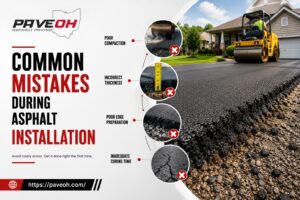
Step 1: Correct asphalt temperature
Asphalt must be compacted while it is hot enough to remain workable.
If it cools too fast:
- Density becomes harder to achieve
- Weak spots remain
- Surface texture suffers
Timing is critical.
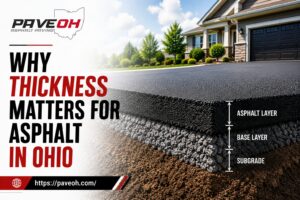
Step 2: Layer thickness control
The asphalt must be placed at the correct thickness before rolling.
If it is too thick:
- The lower layer may stay soft
- Compaction becomes uneven
If it is too thin:
- Structural strength is reduced
Proper thickness matters.
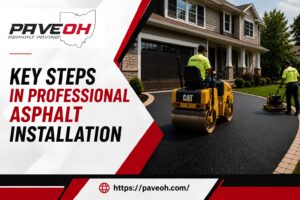
Step 3: Rolling sequence
Professional crews use a rolling pattern to achieve even density.
This often includes:
- Breakdown rolling
- Intermediate rolling
- Finish rolling
Each stage helps increase density while smoothing the surface.
Step 4: Edge compaction
Edges are often weaker if not compacted correctly.
Strong edges help prevent:
- Crumbling
- Water intrusion
- Side cracking
This is especially important for residential driveways.
Why compaction affects pavement lifespan
One of the biggest factors in pavement life is density.
Higher density usually means:
- Better durability
- Better flexibility
- Better resistance to moisture
- Better load-bearing ability
For professional paving experts in Columbus Ohio, achieving proper density is a critical part of long-term pavement performance.
Without that density, the surface ages faster.
Proper compaction helps asphalt last longer by:
- Slowing oxidation
- Reducing moisture damage
- Lowering crack formation
- Preventing early potholes
- Improving surface stability
Signs of poor compaction
Property owners may notice warning signs after installation.
Watch for:
- Tire marks appearing too soon
- Soft spots
- Uneven sinking
- Early cracks
- Surface raveling
- Water pooling
- Edge breakdown
These are often signs the pavement did not reach proper density.
Why professional equipment matters
Compaction requires specialized rollers and equipment.
Professional paving crews use:
- Vibratory rollers
- Steel drum rollers
- Pneumatic rollers
- Compaction testing methods
These tools help ensure the asphalt reaches proper density.
DIY or inexperienced crews often lack this equipment, which can lead to inconsistent results.
That is why hiring experienced professionals matters.
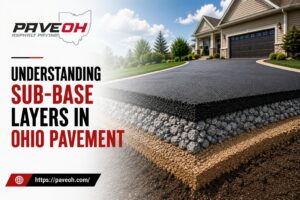
Compaction and base preparation work together
Compaction is not just about the asphalt surface.
The base underneath must also be compacted properly.
Pave OH emphasizes strong base preparation, grading, and foundation work before asphalt installation.
That matters because:
- Weak base equals weak pavement
- Soft subgrade causes sinking
- Poor drainage weakens support
Even perfect asphalt compaction cannot fix a bad base.
Both layers must work together.
Why Ohio homeowners should pay attention to compaction
Many property owners focus on:
- Price
- Appearance
- Speed of installation
But compaction often matters more than all three.
A driveway that looks great today can fail early if the density is poor.
For Ohio properties, where weather conditions are demanding, this step becomes even more important.
Proper compaction protects the investment.
Our paving services in Columbus Ohio
At Pave OH, we understand that quality asphalt starts from the ground up. Our team handles every step of the paving process, including grading, base preparation, asphalt installation, and proper compaction.
Our services include:
- Residential driveway paving
- Commercial parking lot paving
- Asphalt resurfacing
- Asphalt repair
- New asphalt installation
- Full tear-out and replacement
As one of the trusted providers of asphalt paving in Columbus Ohio, we focus on long-term durability, smooth finishes, and strong pavement performance built for Ohio weather.
Our team of professional paving experts in Columbus Ohio uses proven equipment, proper rolling methods, and detailed site preparation to deliver asphalt surfaces designed to last.
Final thoughts
Proper compaction is one of the most important parts of any asphalt project. It affects strength, moisture resistance, durability, and long-term performance.
In Ohio, where freeze-thaw cycles, rain, and traffic create constant pressure on pavement, proper compaction becomes even more critical.
For anyone researching asphalt compaction Ohio, understanding this process can help you choose better contractors and protect your investment.
The pavement may look finished once the asphalt is laid—but the real strength comes from how well it is compacted.