How Do Potholes Form in Ohio? Why do potholes seem to appear so quickly after an Ohio winter? The answer usually involves a combination of water, temperature changes, pavement weaknesses, and traffic. Understanding how potholes Ohio roads and driveways develop can help property owners recognize early warning signs and address damage before it becomes more extensive.
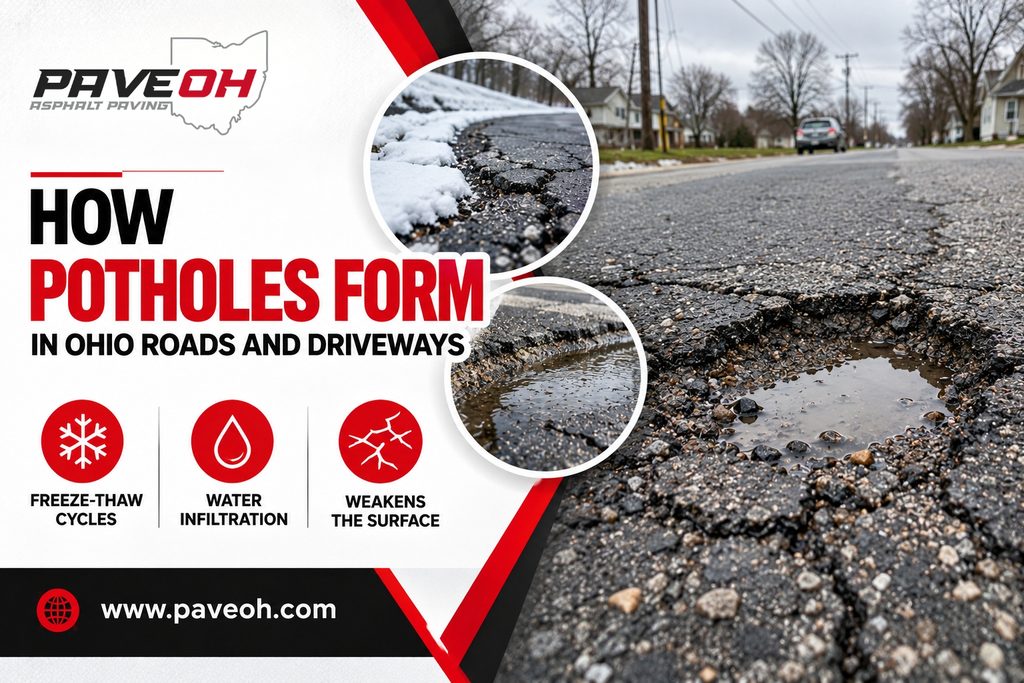
Pave OH identifies freeze-thaw cycles, heavy traffic, drainage problems, and water infiltration as major contributors to pothole development in Central Ohio. When water enters cracks or weakened areas and temperatures fluctuate, pavement can gradually lose strength. Traffic then places repeated loads on those weakened areas, causing pieces of asphalt to break away.
For pavement that has widespread surface deterioration, asphalt resurfacing may also be considered when the underlying structure remains stable. Pave OH explains that resurfacing restores the surface with a new asphalt layer without necessarily removing the entire existing pavement structure.
1. Water Is One of the Main Causes of Potholes
Potholes often begin with moisture.
Asphalt may develop small cracks through normal aging, traffic, weather exposure, or temperature changes. Once water enters those openings, it can reach lower pavement layers and weaken areas beneath the surface.
Pave OH explains that water infiltration is one of the common causes of asphalt deterioration and that untreated cracks can eventually contribute to potholes and base failure.
This is why a small crack should not automatically be considered harmless.
2. Freeze-Thaw Cycles Put Stress on Asphalt
Ohio’s winter conditions create an important part of the pothole formation process.
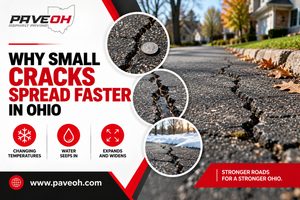
When temperatures fall below freezing, water within pavement cracks and other openings can freeze. When temperatures rise, the ice melts and leaves space that may allow additional water to enter.
Repeated freezing and thawing can progressively weaken pavement.
Pave OH specifically identifies Ohio’s freeze-thaw cycles as a major factor in pothole formation and pavement deterioration.
A simplified process looks like this:
Crack develops → water enters → water freezes → pavement is stressed → water melts → additional moisture enters → repeated cycles weaken the area → traffic breaks the weakened pavement
3. Traffic Turns Weak Areas Into Potholes
Weather alone doesn’t necessarily create every pothole.
Traffic plays an important role because vehicles repeatedly place loads on pavement.
Once the pavement has been weakened by moisture and temperature changes, repeated vehicle loading can cause the damaged area to break apart.
Pave OH notes that heavy traffic can accelerate pothole formation, particularly when combined with freeze-thaw cycles and drainage problems.
This is particularly noticeable in:
- Parking lot drive lanes
- Intersections
- Driveway entrances
- Turning areas
- Busier road sections
- Areas used by heavier vehicles
4. Poor Drainage Can Accelerate Pothole Formation
Water needs somewhere to go.
When drainage is inadequate, water may remain on or beneath the pavement longer than it should.
Pave OH identifies drainage issues as a contributing factor in pothole development and recommends evaluating drainage when repairing damaged asphalt.
Common warning signs include:
- Standing water after rain
- Repeated puddles
- Water flowing across the pavement
- Soft areas
- Edge erosion
- Potholes that repeatedly return after patching
If a pothole keeps coming back in the same location, the underlying drainage or base condition may need to be investigated.
5. Small Cracks Can Become Larger Pavement Problems
Potholes don’t usually appear completely without warning.
In many situations, cracking develops first.
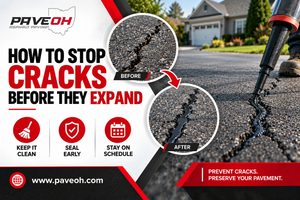
Pave OH explains that cracks allow water to penetrate the pavement and can eventually contribute to more extensive damage, including potholes and base failure.
This is why crack maintenance is an important part of pothole prevention.
Watch for:
- Long cracks
- Interconnected cracks
- Cracks near pavement edges
- Cracks around previous repairs
- Cracking around areas where water collects
The earlier these conditions are identified, the more options may be available for maintenance or repair.
6. Weak Base Conditions Can Contribute to Potholes
The asphalt surface isn’t the only part of a pavement system.
Beneath the asphalt are supporting layers that help distribute traffic loads.
If the base or subbase becomes weakened by moisture, poor drainage, inadequate preparation, or other conditions, the asphalt surface can eventually fail.
Pave OH’s pothole repair process specifically includes evaluating underlying base conditions rather than simply repairing the visible hole.
This is important because covering a pothole without addressing an underlying problem may not provide a lasting solution.
7. Winter Often Reveals Existing Pavement Weaknesses
Property owners may notice many new potholes after winter, but winter isn’t necessarily the only time the damage develops.
Weaknesses can exist before freezing temperatures arrive.
Winter conditions can expose or accelerate those weaknesses through:
- Freezing water
- Thawing
- Snow and ice
- Repeated temperature changes
- Vehicle traffic
- Moisture infiltration
That’s why a spring pavement inspection is useful for identifying damage that appeared or expanded during winter.
8. Driveway Potholes Can Develop for the Same Reasons
Potholes aren’t limited to public roads.
Residential driveways can experience similar problems.
Pave OH identifies weather and traffic among common causes of residential driveway cracks and potholes.
Driveway potholes can be associated with:
- Water infiltration
- Freeze-thaw cycles
- Poor drainage
- Aging asphalt
- Weak areas
- Repeated vehicle loading
- Previous pavement damage
A driveway may experience less traffic than a major road, but it can still deteriorate when moisture and pavement weaknesses combine.
9. Repeated Patching Can Signal an Underlying Problem
Sometimes a pothole is repaired but returns later.
That can be a warning sign.
If the same location repeatedly fails, the problem may involve more than the visible surface.
Possible contributing conditions can include:
- Base instability
- Drainage problems
- Continuing water infiltration
- Heavy traffic
- Extensive pavement deterioration
Pave OH’s repair approach includes assessing the pavement foundation and drainage conditions before selecting a repair method.
The objective is to understand why the pothole formed rather than simply filling the hole repeatedly.
10. Why Potholes Become Larger Over Time
Once a pothole forms, traffic continues to act on its edges.
Vehicles can loosen additional pieces of asphalt around the damaged area. Water can also collect inside the depression, potentially contributing to further deterioration.
Pave OH recommends timely pothole repair because untreated potholes can expand and contribute to more extensive pavement damage.
A small pothole may therefore be much easier to manage than a large area of pavement failure surrounding it.
Common Causes of Potholes in Ohio
| Cause | How It Contributes |
|---|---|
| Freeze-thaw cycles | Repeated temperature changes stress weakened pavement |
| Water infiltration | Moisture can weaken pavement and supporting layers |
| Poor drainage | Standing or trapped water increases moisture exposure |
| Heavy traffic | Repeated loads stress weakened pavement |
| Existing cracks | Provide pathways for moisture |
| Weak base | Reduces pavement support |
| Aging asphalt | Older pavement can become more vulnerable to deterioration |
| Lack of maintenance | Allows developing problems to progress |
Several of these factors can occur at the same time, which is why pothole formation is often a gradual process rather than the result of one isolated event.
How to Tell If a Pothole Is Getting Worse
Regular inspection can help property owners identify changes.
Look for:
Increasing width
The pothole becomes noticeably wider.
Increasing depth
The damaged area becomes deeper or exposes underlying material.
Crumbling edges
More asphalt begins breaking away around the perimeter.
Water accumulation
Water repeatedly collects inside or around the pothole.
Nearby cracking
Additional cracks appear around the damaged area.
Recurring repairs
The same location repeatedly develops damage after patching.
These signs can indicate that the pavement needs more than a basic surface treatment.
How Professionals Repair Potholes
The appropriate repair method depends on the size, severity, location, and underlying cause.
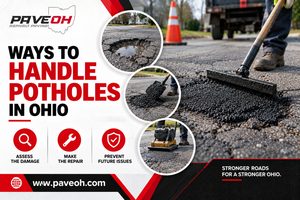
Pave OH describes a repair process that includes:
- Inspection and assessment
- Cleaning and preparation
- Cutting and patching where appropriate
- Application of asphalt
- Compaction
- Final inspection
The company also offers hot-mix asphalt patching, infrared thermal repair, and cold patch applications depending on project conditions.
Proper preparation and compaction are important because a repair needs to bond with the surrounding pavement and provide adequate support.
Why Compaction Matters
A pothole repair isn’t complete simply because the hole has been filled.
The material needs to be properly compacted to create a stable surface.
Pave OH includes compaction as a specific stage of its pothole repair process to create a smooth, level, and durable finish.
Insufficient preparation or compaction can contribute to premature failure.
When Is Pothole Repair Enough?
A localized repair may be appropriate when the surrounding pavement remains generally sound.
For example, an isolated pothole surrounded by stable asphalt may be addressed with targeted patching.
Pave OH offers pothole patching and other localized repair methods for damaged areas while reserving more extensive solutions for pavement with broader deterioration.
However, the condition of the surrounding pavement should always be considered.
When Might Resurfacing Be Appropriate?
Sometimes potholes are only one symptom of widespread surface deterioration.
If the pavement has extensive surface wear but the underlying structure remains stable, resurfacing may be an option.
Pave OH describes asphalt resurfacing as applying a new asphalt layer over properly prepared existing pavement. It is intended for pavement that still has sufficient structural integrity to support the new layer.
Resurfacing may be considered when:
- Surface deterioration is widespread
- Cracking is becoming extensive
- The pavement looks significantly worn
- Local repairs are becoming frequent
- The underlying base remains stable
A professional inspection should determine whether resurfacing is appropriate.
When Is Full Replacement More Appropriate?
Resurfacing isn’t suitable for every pothole-damaged pavement.
If the underlying base has failed or the pavement has widespread structural deterioration, simply adding another surface layer may not solve the problem.
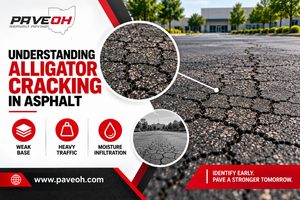
Pave OH identifies conditions such as widespread alligator cracking, multiple deep potholes, failing base layers, severe drainage problems, and extensive deterioration as situations where full replacement may need to be considered.
The correct solution depends on what is happening beneath the visible surface.
How to Prevent Potholes in Ohio
Potholes cannot always be prevented, but property owners can take steps to reduce conditions that contribute to their development.
1. Maintain drainage
Prevent water from repeatedly collecting on pavement.
2. Monitor cracks
Address appropriate cracks before they become larger openings.
3. Inspect after winter
Look for new potholes and expanding cracks.
4. Maintain the pavement
Use appropriate preventative maintenance while the pavement remains suitable.
5. Repair damage promptly
Don’t allow small potholes to remain untreated indefinitely.
6. Investigate recurring failures
If a repair repeatedly fails, look for an underlying drainage or structural problem.
Pave OH recommends proactive maintenance, including spring inspections, crack sealing, drainage checks, and appropriate sealcoating as part of a broader strategy for reducing pothole development.
How Resurfacing Can Help Aging Pavement
When potholes occur alongside widespread surface deterioration, resurfacing can provide a renewed pavement surface.
Pave OH’s resurfacing process begins with inspection and evaluation to determine whether the existing pavement can support a new asphalt layer. Preparation may include addressing damaged areas before the new surface is installed.
This can provide:
- A smoother surface
- Improved appearance
- Better surface performance
- Extended pavement service life
- Reduced need for repeated localized repairs when the underlying pavement is suitable
Resurfacing should not be viewed as a universal pothole solution. The existing pavement structure must first be evaluated.
Final Thoughts
The formation of potholes Ohio property owners encounter is usually connected to several factors working together. Water enters cracks or vulnerable areas, freezing and thawing create repeated stress, and vehicle traffic places additional loads on pavement that has already been weakened. Poor drainage, aging asphalt, and weak base conditions can make the problem worse. Pave OH identifies these same factors as common contributors to pothole formation in Central Ohio.
The best response depends on the extent of the damage. An isolated pothole may require targeted patching, while widespread surface deterioration may make resurfacing worth evaluating. If the pavement’s base or underlying structure has failed, more extensive reconstruction may be necessary. Pave OH’s resurfacing guidance emphasizes that an existing pavement must have adequate structural integrity before an overlay is considered.
For property owners considering asphalt resurfacing in Columbus Ohio, Pave OH evaluates the existing pavement, including surface condition and structural stability, before recommending a solution. Its resurfacing service is designed for worn pavement that can support a new asphalt layer without requiring complete removal.
Regular inspections, proper drainage, crack maintenance, and timely pothole repairs can all help prevent isolated problems from developing into larger pavement failures. When damage becomes widespread, a professional evaluation can help determine whether repair, resurfacing, or replacement is the appropriate next step.