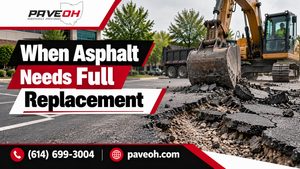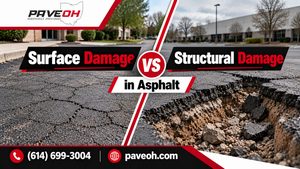
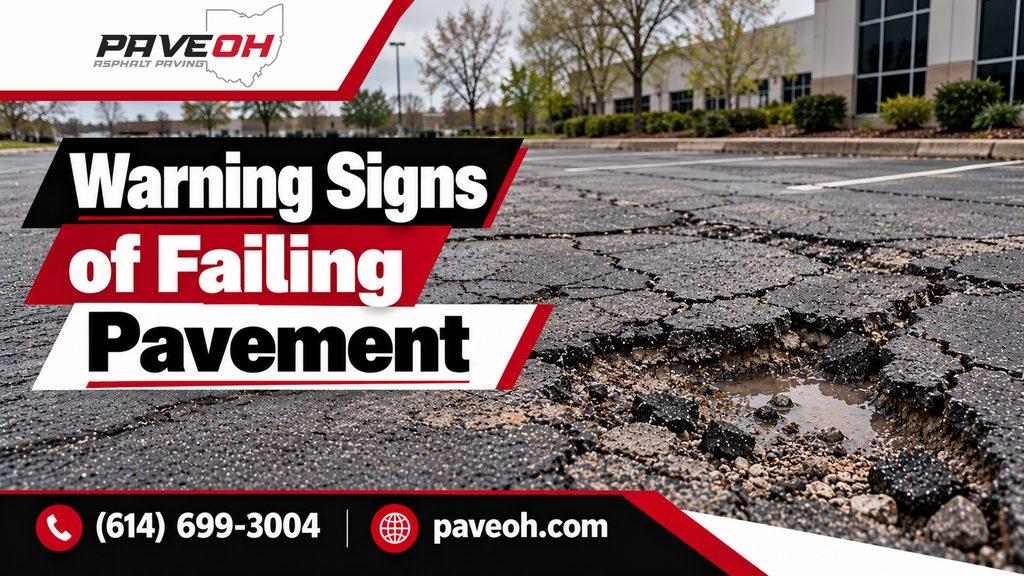
What are the warning signs of failing pavement in Ohio? The most common failing pavement signs Ohio property owners should watch for include widespread cracking, recurring potholes, sinking areas, water pooling, crumbling edges, and visible surface deterioration. These problems may indicate anything from minor surface wear to serious damage beneath the pavement. Recognizing them early helps homeowners, business owners, and property managers determine whether maintenance, repairs, resurfacing, or replacement is the appropriate solution.
Pavement deterioration rarely happens for just one reason. Ohio’s changing weather, repeated vehicle traffic, moisture infiltration, soil movement, and the condition of the original pavement installation can all affect how well an asphalt surface performs. A driveway may develop a few isolated cracks while remaining structurally sound, whereas a parking lot with widespread cracking and depressions may need a more comprehensive assessment.
Pave OH provides paving solutions for residential and commercial properties throughout Columbus and Central Ohio. Understanding the early warning signs can help property owners make informed maintenance decisions and address developing problems before they become more extensive.
1. Widespread Cracking Across the Pavement
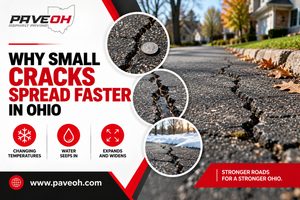
Cracks are among the earliest visible signs that an asphalt surface needs attention. However, not all cracks indicate the same problem. Their pattern, width, location, and severity can help identify whether deterioration is primarily at the surface or may extend into the pavement structure.
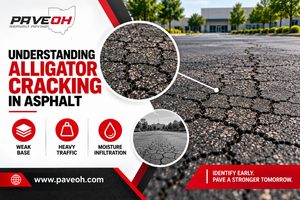
Alligator cracking
Alligator cracking appears as interconnected cracks that form small, irregular shapes resembling an alligator’s skin. It often develops in areas subjected to repeated vehicle loading, particularly when the pavement or its supporting layers have weakened.
This pattern deserves attention because extensive alligator cracking can indicate structural distress. Simply filling the visible cracks may not correct a weak base or unstable foundation.
Longitudinal and transverse cracks
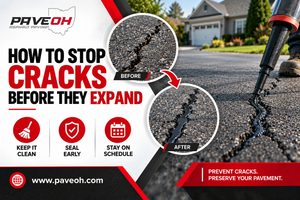
Longitudinal cracks run along the pavement, while transverse cracks extend across it. Depending on their location and pattern, they may be associated with temperature-related movement, construction joints, underlying conditions, or other pavement stresses.
A few narrow cracks may be manageable with suitable maintenance. However, cracks that widen, multiply, or develop alongside potholes and depressions deserve a closer assessment.
Block cracking
Block cracking creates a pattern of larger interconnected rectangular sections. It can develop as asphalt ages and becomes less flexible. Although block cracking does not always indicate the same structural problem as alligator cracking, widespread deterioration can make maintenance more difficult.
The key is to evaluate the overall condition rather than treating every crack as an isolated defect.
2. Potholes Keep Appearing After Repairs
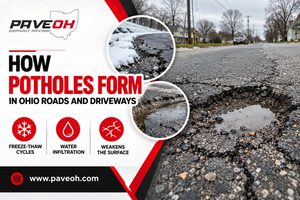
Potholes are a common warning sign that pavement has deteriorated beyond its original condition. They develop when weakened asphalt breaks apart and material is dislodged from the surface.
Moisture can contribute to this process by entering cracks and affecting the supporting layers. Repeated vehicle loads then place additional stress on weakened sections. Seasonal temperature changes can also aggravate existing pavement defects.
One pothole does not automatically mean the entire pavement needs replacement. A localized defect may be repaired when the surrounding material and foundation remain stable.
However, recurring potholes across several locations can indicate that the underlying cause has not been resolved. If the same areas continue breaking apart after patching, the pavement may need a more detailed evaluation.
Watch for these additional symptoms:
- Potholes becoming larger or deeper.
- Loose asphalt pieces surrounding damaged areas.
- Cracks spreading around previous patches.
- Several potholes developing within a short period.
- Water collecting in or around damaged sections.
Potholes should not be ignored simply because they appear small. Prompt assessment helps determine the appropriate repair method and whether a wider area needs attention.
3. Standing Water Remains After Rain
Water pooling is one of the most useful warning signs to observe after rainfall. A properly designed pavement surface should direct water toward suitable drainage areas rather than allow persistent puddles to form.
When water repeatedly collects in the same location, possible causes include low spots, incorrect grading, settlement, blocked drainage routes, or changes in the surrounding ground.
The concern is not limited to appearance. Water that enters pavement cracks can contribute to deterioration beneath the surface. If the supporting materials become weakened, the pavement may begin to settle or crack under traffic.
Pay attention to both the location and frequency of standing water. A puddle that repeatedly forms near a driveway entrance may point to a different issue from several low areas scattered across a parking lot.
The correct response depends on the underlying cause. Small surface irregularities may require localized correction, while widespread drainage problems combined with structural deterioration may require more extensive work.
4. The Pavement Is Sinking or Developing Uneven Areas
A stable pavement surface should not have significant depressions, sudden changes in level, or areas that continue sinking over time.
Settlement occurs when pavement or the materials underneath it move downward. Potential causes include insufficient compaction, unstable supporting soil, moisture-related weakening, or changes in ground conditions.
These uneven areas can affect vehicle movement, create standing water, and place additional stress on nearby pavement. In commercial properties, severe depressions can also interfere with normal parking and site access.
Not every uneven area indicates major failure. Some defects may be limited to the surface and can be corrected with suitable work. However, widespread settlement or movement that continues after previous repairs warrants a closer examination of the base and subgrade.
Before choosing a treatment, identify whether the pavement itself is deteriorating or whether its foundation is contributing to the movement. Addressing the underlying issue is important for achieving a durable result.
5. Deep Ruts Develop in Vehicle Wheel Paths
Rutting occurs when depressions form along the paths where vehicle tires repeatedly travel. These depressions may become particularly noticeable in areas that receive frequent traffic, including parking lanes, driveway entrances, and delivery zones.
Rutting can develop because of movement or consolidation within one or more pavement layers. Traffic loading, material properties, moisture, and the condition of the foundation may all contribute.
Early rutting may appear as shallow lines that follow vehicle wheel paths. As deterioration progresses, the depressions may become more pronounced and collect water.
The extent of rutting matters when deciding what to do next. A limited surface problem may be treated differently from deep ruts that indicate instability in the supporting layers.
A qualified evaluation should consider the rut depth, the area affected, traffic demands, and the condition of adjacent pavement. A surface treatment alone may not be appropriate when deeper structural issues are present.
6. Asphalt Is Crumbling and Losing Its Aggregate
As asphalt ages, its surface may begin losing small particles of aggregate. This deterioration is often called raveling. The pavement may appear rough, loose, pitted, or increasingly uneven as pieces of material separate from the surface.
Raveling can be associated with aging, weather exposure, inadequate bonding between materials, construction-related issues, or the effects of moisture and traffic.
Early surface deterioration does not necessarily mean full replacement is required. The appropriate maintenance method depends on the depth of damage and whether the asphalt beneath the affected layer remains stable.
More extensive crumbling is concerning when the surface breaks apart across broad areas or occurs alongside deep cracking, potholes, and settlement.
Property owners should also examine edges, corners, and previously repaired sections. When several forms of deterioration appear together, the problem may be more significant than ordinary surface aging.
7. Pavement Edges Are Breaking or Separating
The edges of asphalt driveways and paved areas can be vulnerable when they lack sufficient support or are exposed to repeated vehicle loading and water erosion.
Warning signs include crumbling edges, sections breaking away, cracks running parallel to the boundary, and a noticeable drop between the asphalt and surrounding ground.
Edge deterioration can begin locally and gradually spread. Water flowing along the pavement boundary may erode supporting materials, while vehicles driving too close to the edge can place additional stress on the area.
Small, isolated defects may be repairable if the supporting materials remain stable. More extensive edge failure may require rebuilding the affected section and correcting the conditions that contributed to the damage.
Proper grading and suitable edge support are important considerations whenever significant repairs or new paving work are performed.
8. Repairs Are Becoming More Frequent
Repeated repairs can be a sign that the pavement needs more attention than routine maintenance alone.
For example, an isolated pothole can often be addressed with a suitable patch. However, if cracks repeatedly return around patches or new potholes appear across the surface, the pavement may have an unresolved underlying problem.
Common contributors include inadequate drainage, weakened base materials, recurring moisture infiltration, and deterioration that extends beyond the original repair area.
Keep a basic record of where defects occur and whether they return after repairs. This can help identify patterns and make an assessment more useful.
The answer is not always to replace the entire surface. A pavement with localized defects and a stable foundation may still benefit from targeted repair. Conversely, widespread structural deterioration may make repeated patching less suitable as a long-term approach.
The goal is to understand why the pavement keeps failing rather than simply treating the latest visible defect.
9. The Pavement Looks Faded, Dry, or Brittle
Changes in asphalt color can provide clues about surface aging, but appearance alone cannot establish whether pavement has failed.
New asphalt is generally dark, while older asphalt often becomes lighter as it experiences sunlight, weather exposure, and normal wear. Over time, aging binder can contribute to reduced flexibility and increased susceptibility to cracking.
Look beyond the color of the pavement. A faded surface with only minor wear may remain serviceable, while fading combined with crumbling, extensive cracking, or loose aggregate may indicate more advanced deterioration.
Regular inspection helps distinguish ordinary aging from damage that needs intervention.
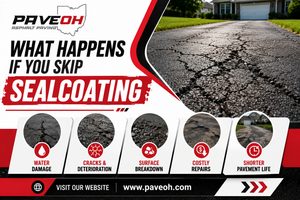
Maintenance should be selected according to the pavement’s actual condition. A protective surface treatment may be suitable for some sound asphalt surfaces, but it cannot correct extensive structural failure or an unstable foundation.
10. The Surface Has Become Rough or Uneven
A pavement surface can become uncomfortable or difficult to use when it develops bumps, dips, loose material, or irregular transitions between repaired sections.
These changes may result from aging, surface deformation, previous repairs, settlement, or deterioration caused by traffic and water.
For residential properties, an uneven driveway can affect vehicle access and the movement of people across the area. For commercial properties, an irregular parking surface may interfere with normal traffic flow and site use.
The appropriate treatment depends on the source of the unevenness. Some surface defects can be corrected without rebuilding the entire pavement, while deeper settlement or widespread structural problems may require more extensive work.
An assessment should look at the overall surface profile and how the uneven areas relate to cracks, drainage patterns, and previous repairs.
11. How to Decide Between Repair, Resurfacing, and Replacement
Seeing warning signs does not automatically mean the entire pavement needs to be replaced. Different treatments address different levels of deterioration.
| Pavement condition | Possible concern | Treatment to evaluate |
|---|---|---|
| A few narrow cracks | Localized surface deterioration | Appropriate crack maintenance |
| One isolated pothole | Localized asphalt failure | Patching and assessment of the affected area |
| Faded surface with minor wear | Surface aging | Suitable preventive maintenance |
| Rough or deteriorated surface with stable support | Surface-level deterioration | Resurfacing assessment |
| Deep ruts or widespread unevenness | Possible deformation in pavement layers | Detailed pavement assessment |
| Extensive alligator cracking | Possible structural distress | Evaluate full-depth repairs or replacement |
| Repeated settlement and water pooling | Drainage or foundation concerns | Correct underlying conditions |
| Widespread crumbling and recurring potholes | Advanced deterioration | Compare comprehensive repairs with replacement |
This comparison is a general guide. An inspection is needed to determine the source of the damage and select an appropriate treatment.
When pavement repairs may be enough
Repairs may be suitable when defects are limited to specific locations and the surrounding pavement remains stable. The repair method should account for the severity of the defect and any underlying cause.
Asphalt pavement repair in Columbus Ohio is relevant when homeowners or property managers need to address localized cracks, potholes, or damaged sections without automatically replacing the entire surface.
When resurfacing may be appropriate
Resurfacing adds a new asphalt layer over an existing surface that is suitable to remain in place. It can improve the appearance and function of pavement that has surface deterioration but a sufficiently stable structure.
Asphalt resurfacing in Columbus Ohio may be worth considering when the top layer has deteriorated but the foundation remains sound. Extensive base failure, severe settlement, or unresolved drainage problems should be evaluated before a resurfacing plan is selected.
When replacement deserves consideration
Replacement may be appropriate when deterioration is widespread, the supporting layers have failed, or repeated repairs are no longer providing a suitable result.
Blacktop replacement in Columbus Ohio is an option to evaluate when an existing asphalt surface has extensive damage that cannot be effectively addressed through localized repairs or a suitable resurfacing treatment.
A replacement plan should consider the existing foundation, required excavation, grading, drainage, pavement thickness, and expected traffic. Rebuilding without correcting the conditions that caused the original failure can allow similar problems to return.
12. Why Ohio Weather Can Accelerate Pavement Deterioration
Ohio asphalt surfaces experience seasonal weather changes, rainfall, and periods of freezing and thawing. These conditions can contribute to deterioration, especially when water enters cracks or the supporting materials are vulnerable to moisture.
During colder conditions, water in pavement openings or supporting materials may freeze and expand. As temperatures fluctuate, repeated freeze-thaw cycles can worsen existing defects. Rainfall can also reveal drainage issues or increase moisture exposure in weak areas.
Weather is only one part of the picture. Pavement installation, material quality, foundation preparation, traffic loading, and maintenance history also influence performance.
That is why pavement evaluations should consider the property’s specific conditions. A driveway with adequate drainage and a stable foundation may perform differently from a similarly aged surface that repeatedly collects water.
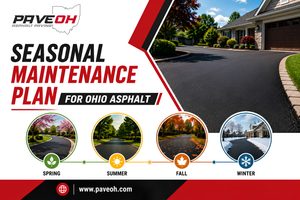
Timely maintenance can help address manageable defects, while a professional assessment can determine when deterioration has progressed beyond routine care.
13. Warning Signs Property Owners Should Not Ignore
Some pavement defects deserve more immediate attention because they can indicate continuing deterioration or affect how the surface is used.
Pay closer attention when:
- Cracks expand rapidly or spread across a large area.
- Several potholes appear in the same section.
- The pavement continues sinking after previous repairs.
- Water repeatedly collects in depressions.
- Large portions of asphalt are breaking apart.
- Deep ruts affect vehicle movement.
- Repairs fail repeatedly in the same locations.
These symptoms do not all require the same treatment. Their significance depends on their severity, extent, and cause.
For example, a small pothole in otherwise stable pavement may be manageable with a targeted repair. Widespread cracking combined with sinking and persistent water pooling may require a more detailed evaluation of the entire pavement system.
Recognizing these differences helps property owners avoid choosing a treatment based only on the appearance of the surface.
14. How Pave OH Can Help Property Owners Address Failing Pavement
Identifying pavement deterioration is the first step toward selecting the right solution. The next step is determining the extent of the problem and which treatment is suitable for the property.
Paving services in Columbus Ohio are relevant for property owners who need help evaluating new paving, pavement improvements, resurfacing, or replacement options. Pave OH serves residential and commercial customers throughout Columbus and Central Ohio.
For a driveway with widespread deterioration, an assessment can help determine whether localized repairs or more extensive reconstruction should be considered.
Driveway replacement in Columbus Ohio may be appropriate when residential asphalt has deteriorated beyond effective repair. The replacement approach should address the condition of the existing pavement and supporting layers rather than focus on appearance alone.
For business owners and property managers, the pavement’s intended use is also important. Traffic levels, loading requirements, drainage, and access needs can all influence the appropriate approach.
A well-planned paving project begins with understanding the property’s existing conditions. By identifying the cause of deterioration and selecting a suitable treatment, owners can make more informed decisions about maintaining or renewing their pavement.
Frequently Asked Questions About Failing Pavement Signs in Ohio
What are the earliest signs of pavement failure?
Early warning signs include small cracks, slight surface roughness, fading, minor depressions, and occasional water pooling. These symptoms do not necessarily mean the pavement has structurally failed, but they are worth monitoring.
Does alligator cracking mean asphalt must be replaced?
Not always. The appropriate treatment depends on how extensive the cracking is and whether the base remains stable. Small, limited areas may be suitable for full-depth repairs, while widespread alligator cracking can indicate a need for more extensive work.
Why does water pooling on asphalt matter?
Repeated standing water may indicate poor grading, settlement, or drainage problems. Water entering cracks can also contribute to deterioration in the pavement and its supporting layers. The cause should be identified before selecting a repair.
Can failing pavement be resurfaced?
Sometimes. Resurfacing may be suitable when deterioration is mainly at the surface and the existing foundation remains stable. Widespread structural damage or significant movement may require deeper repairs or replacement instead.
How can I tell whether potholes are a serious problem?
Look at their size, frequency, location, and whether they return after repairs. Several recurring potholes accompanied by widespread cracking or settlement may indicate a more extensive problem than one isolated defect.
Does old asphalt always need to be replaced?
No. Age alone is not enough to determine whether pavement needs replacement. Its current condition, maintenance history, drainage performance, and foundation stability are also important.
What should I do if the same pavement defects keep returning?
Arrange an assessment that looks beyond the visible defect. Repeated problems can be associated with unresolved drainage issues, weak supporting materials, or deterioration extending beyond the original repair area.
How can I help prevent premature pavement failure?
Keep drainage paths clear, monitor new cracks and depressions, address suitable maintenance needs promptly, and have recurring defects evaluated. Preventive care is most effective when the pavement remains structurally sound.
Conclusion: Recognize Failing Pavement Before Problems Spread
The most important failing pavement signs Ohio property owners should watch for include widespread cracking, recurring potholes, water pooling, deep ruts, sinking areas, crumbling edges, and repeated repair failures. These conditions can develop gradually, but they may become more difficult to address when their underlying causes remain unresolved.
The right response depends on the extent of deterioration. Localized defects may be repairable, structurally sound pavement with surface wear may qualify for resurfacing, and extensive structural damage may require replacement. Assessing drainage, foundation stability, traffic demands, and the full pattern of damage helps determine which approach is appropriate.
Pave OH offers residential and commercial paving solutions throughout Columbus and Central Ohio. If your driveway, parking area, or other paved surface is showing signs of deterioration, contact Pave OH at (614) 699-3004 to discuss your paving needs and request an estimate.