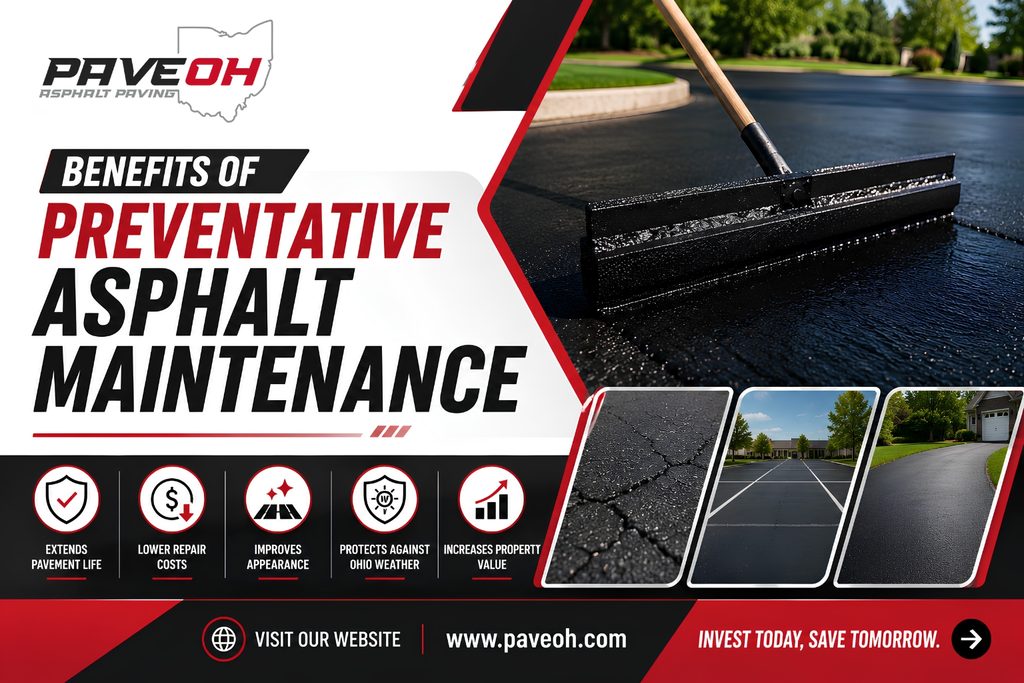
Why Is Preventative Asphalt Maintenance Important in Ohio? Why wait until asphalt develops major cracks, potholes, or structural failures before taking action? Preventative maintenance asphalt Ohio property owners use can help preserve pavement while it is still in relatively good condition. Instead of waiting for deterioration to become extensive, preventative maintenance focuses on identifying and addressing smaller problems before they progress.
The Federal Highway Administration describes pavement preservation as planned work intended to keep pavement in a state of good repair. Its guidance emphasizes that preservation treatments are most effective when pavement condition is still satisfactory because they can slow deterioration, extend service life, and improve functionality.
Ohio has also maintained a statewide focus on pavement preservation. ODOT’s pavement guidance includes treatments such as crack sealing, pavement planing, overlays, and other repair strategies selected according to pavement condition and distress severity.
What Is Preventative Asphalt Maintenance?
Preventative maintenance is the practice of taking action while pavement is still serviceable rather than waiting for serious deterioration.
Depending on pavement condition, maintenance may include:
- Crack sealing
- Surface treatments
- Patching
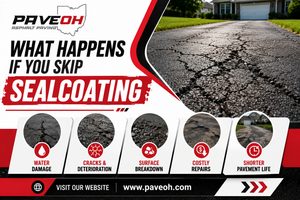
- Sealcoating where appropriate
- Drainage maintenance
- Milling and overlays
- Regular pavement inspections
- Correcting localized problems
The appropriate treatment depends on the type and severity of pavement distress. ODOT specifically notes that selecting an improper repair strategy can contribute to premature failure, while appropriate repair strategies can improve pavement performance and longevity.
1. Preventative Maintenance Helps Slow Pavement Deterioration
Asphalt naturally changes as it ages.
Traffic, moisture, temperature changes, oxidation, and environmental exposure gradually affect pavement. Preventative treatments are designed to slow this process while the pavement remains in usable condition.
The FHWA summarizes the basic preservation principle as keeping satisfactory pavement in good condition so deterioration can be impeded before more extensive rehabilitation is required.
This makes preventative maintenance fundamentally different from emergency repair. Instead of waiting for a major failure, property owners monitor the pavement and respond to developing problems.
2. It Can Help Extend Asphalt Service Life
One of the main purposes of pavement preservation is to keep usable asphalt functioning for longer.
Ohio’s pavement preservation guidance identifies preventive maintenance treatments as methods that can preserve the roadway system, retard future deterioration, and extend pavement service life without substantially increasing structural capacity.
This doesn’t mean every driveway or parking lot will achieve a specific additional number of years. Pavement life depends on factors such as:
- Original construction
- Traffic volume
- Drainage
- Soil and base conditions
- Climate exposure
- Maintenance history
- Existing pavement condition
Preventative maintenance is therefore best viewed as one part of a broader pavement management strategy.
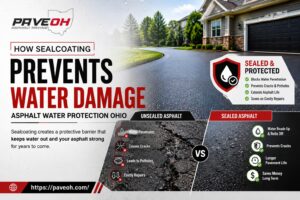
3. Crack Sealing Helps Limit Moisture Entry
Cracks are common starting points for pavement deterioration.
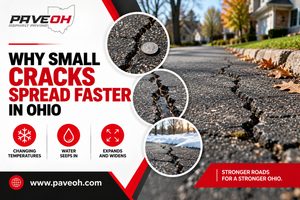
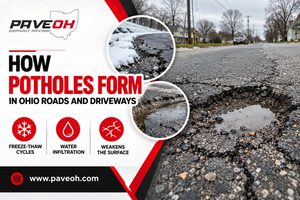
When water enters pavement through cracks, it can contribute to additional damage. This becomes particularly relevant in Ohio, where seasonal freezing and thawing can place additional stress on pavement.
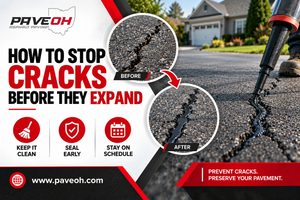
ODOT identifies crack sealing as an appropriate maintenance strategy for certain crack-related distresses. Its pavement guide lists crack sealing among corrective strategies for thermal cracking, block cracking, and certain longitudinal cracking conditions.
The goal isn’t simply to make cracks disappear visually. Proper crack treatment can help reduce moisture infiltration through appropriate pavement openings.
4. Preventative Maintenance Can Help Reduce Water-Related Damage
Water management is essential to asphalt performance.
Moisture can enter through cracks, pavement edges, drainage deficiencies, and other openings. When combined with traffic and temperature changes, moisture can contribute to pavement deterioration.
ODOT’s pavement guide identifies water infiltration as a contributing factor in several pavement distress mechanisms and includes drainage preservation among pavement preservation strategies.
Preventative maintenance may include:
- Sealing appropriate cracks
- Maintaining drainage paths
- Repairing localized pavement damage
- Monitoring standing water
- Correcting appropriate surface drainage issues
The objective is to prevent water from becoming a continuing source of pavement damage.
5. It Helps Address Problems Before They Become Extensive
A small pavement problem does not necessarily require major reconstruction.
For example, isolated cracking may be suitable for crack sealing, while isolated surface deterioration may be addressed with an appropriate localized repair.
ODOT’s pavement repair guide categorizes pavement distress by severity and provides different repair options depending on the condition.
This illustrates why regular inspections matter.
A preventative approach is:
Inspect → Identify → Evaluate → Maintain → Monitor
rather than:
Ignore → Deteriorate → Fail → Reconstruct
6. Preventative Maintenance Can Support Better Pavement Performance
Pavement performance isn’t only about appearance.
A properly maintained surface can provide better drivability and functionality than pavement with extensive deterioration.
ODOT states that appropriate pavement repair strategies are expected to reduce premature failures and improve pavement longevity, while improved pavement condition can provide better drivability and comfort.
For parking lots and driveways, this can translate into a surface that remains more functional for everyday vehicle use.
7. It Can Improve Pavement Appearance
Preventative maintenance can also affect how asphalt looks.
Faded surfaces, isolated cracks, patches, and surface deterioration can make a property appear poorly maintained.
Depending on pavement condition, appropriate surface treatments can improve the appearance of existing asphalt while providing a protective function.
The City of Cincinnati describes preventive surface treatments as methods that seal existing pavement, protect against aging and environmental effects, and improve the appearance of roadway surfaces.
However, cosmetic improvement should not be confused with structural repair. A surface treatment cannot correct major pavement failure underneath.
8. It Can Help Reduce the Need for Major Repairs
Preventative maintenance is intended to address pavement while it remains in a condition where relatively targeted treatments can be effective.
The City of Cleveland’s pavement maintenance study notes that experience has shown ongoing preventive maintenance and rehabilitation can be less expensive over time than allowing pavement to deteriorate to a condition requiring reconstruction.
The key is timing.
Preventative maintenance generally makes the most sense when the pavement is still structurally suitable for the treatment being considered.
9. Preventative Maintenance Supports Better Budget Planning
Unexpected pavement failures can create difficult maintenance decisions.
When property owners regularly inspect pavement and maintain it according to condition, they can better identify developing needs before they become emergencies.
A planned approach allows owners to consider:
- Which areas need attention
- What type of treatment is appropriate
- When work should be scheduled
- Which problems can be monitored
- Which areas may eventually require rehabilitation
For commercial properties, this type of planning can be particularly useful because pavement work can affect parking, traffic flow, deliveries, and daily operations.
10. It Helps Property Owners Track Pavement Condition
Preventative maintenance starts with knowing what condition the pavement is in.
ODOT recommends documenting pavement distress and considering pavement history, including age, previous maintenance, overlays, and progression of deterioration during pavement evaluation.
Property owners can maintain a simple record containing:
| Information | Why Track It? |
|---|---|
| Inspection date | Shows when pavement was evaluated |
| Crack locations | Makes changes easier to monitor |
| Potholes | Tracks developing failures |
| Drainage issues | Identifies recurring moisture concerns |
| Previous repairs | Provides maintenance history |
| Surface treatments | Helps plan future maintenance |
| Photos | Makes deterioration easier to compare |
Documentation becomes particularly useful for large parking lots and commercial properties.
11. Ohio’s Freeze-Thaw Cycles Make Prevention Important
Ohio pavement experiences seasonal temperature changes that can affect asphalt.
ODOT identifies thermal cracking as a distress associated with cold temperatures, where asphalt layers contract as temperatures fall. Asphalt aging can also contribute to thermal cracking.
Moisture can add another challenge.
When water enters pavement openings and temperatures drop below freezing, the repeated freezing and thawing process can contribute to pavement deterioration.
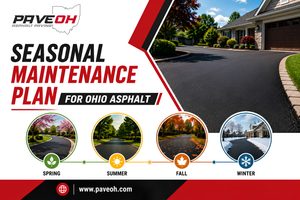
This is one reason preventative maintenance should include attention to cracks and drainage before winter conditions arrive.
12. Preventative Maintenance Can Include Surface Treatments
Surface treatments are one category of pavement preservation.
Depending on pavement condition and project requirements, treatments may include crack sealing, fog seals, seal coats, or other appropriate preservation methods.
ODOT’s construction specifications reference fog sealing as a treatment intended to add life and longevity, seal narrow cracks, restore flexibility at the pavement surface, and reduce oxidation-related raveling and aggregate loss.
The treatment should be selected based on the pavement’s actual condition rather than applying the same treatment to every property.
13. Milling and Overlays Can Be Preventative or Rehabilitative
Preventative maintenance doesn’t always mean applying a thin surface treatment.
When a pavement surface has progressed beyond what a simple treatment can address but the underlying structure remains suitable, milling and an overlay may be considered.
ODOT’s pavement repair guide lists pavement planing and overlays among potential strategies for certain pavement distresses.
Milling can remove deteriorated surface material, while the overlay provides a renewed asphalt surface.
This is more substantial than routine crack sealing but may still avoid complete reconstruction when pavement conditions allow.
14. Drainage Maintenance Is Part of Pavement Preservation
Good drainage helps protect asphalt.
Water should be directed away from the pavement or toward appropriate drainage structures instead of remaining on the surface.
ODOT’s statewide pavement preservation information specifically includes drainage preservation among recognized maintenance treatments.
Property owners should therefore inspect:
- Drainage inlets
- Pavement slopes
- Low spots
- Edges
- Areas where water repeatedly collects
Correcting drainage issues can be an important part of protecting pavement from continued moisture exposure.
15. Preventative Maintenance Is Not Appropriate for Every Pavement
This is an important distinction.
Preventative treatments work best when pavement remains sufficiently sound.
Guidance from TxDOT, for example, explains that pavements with extensive cracking, potholes, patches, or unstable asphalt may not be good candidates for preventive maintenance and may instead require reconstruction.
Similarly, ODOT’s repair guide distinguishes between pavement distresses and recommends different strategies based on severity.
A professional evaluation may be necessary when pavement has:
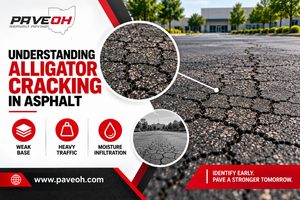
- Extensive alligator cracking
- Major settlement
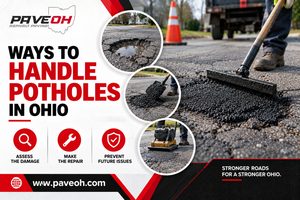
- Numerous potholes
- Severe rutting
- Structural failure
- Significant base problems
- Persistent drainage issues
The earlier maintenance begins, the greater the range of potential treatment options may be.
Preventative Maintenance vs. Reactive Repairs
| Preventative Maintenance | Reactive Repair |
|---|---|
| Addresses developing problems | Responds to visible failure |
| Planned in advance | Often triggered by damage |
| Can include crack sealing | May involve pothole repair |
| Includes pavement inspections | Often follows a complaint or failure |
| Focuses on preserving sound pavement | Focuses on restoring damaged areas |
| Can support longer service life | May be more extensive if deterioration is advanced |
Neither approach eliminates the need for the other. Even well-maintained pavement eventually requires repairs as it ages.
When Should Ohio Property Owners Start Preventative Maintenance?
The answer depends on pavement condition rather than a single age.
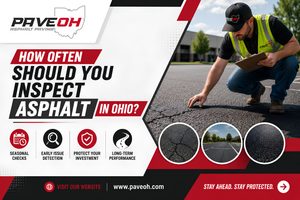
A useful starting point is to establish a regular inspection schedule.
Inspect regularly for:
- Cracking
- Potholes
- Raveling
- Rutting
- Drainage problems
- Surface oxidation
- Settlement
- Edge deterioration
ODOT recommends systematic pavement distress surveys and recording relevant pavement information during evaluation.
Once a problem is identified, its severity can be evaluated and the appropriate treatment selected.
A Simple Preventative Asphalt Maintenance Plan
Step 1: Inspect
Check pavement regularly, especially after winter and severe weather.
Step 2: Document
Record cracks, potholes, drainage issues, and previous repairs.
Step 3: Evaluate
Determine whether the issue is cosmetic, surface-level, or structural.
Step 4: Select the Treatment
Possible treatments can include crack sealing, patching, surface treatments, milling, overlays, or reconstruction depending on pavement condition.
Step 5: Schedule the Work
Plan maintenance before deterioration becomes extensive when practical.
Step 6: Monitor
Continue inspecting the pavement after treatment to determine how it performs.
This process follows the general pavement-preservation principle of maintaining pavement while it remains in satisfactory condition.
Final Thoughts
The biggest benefit of preventative maintenance asphalt Ohio property owners use is that it shifts pavement care from a reactive approach toward a planned one. Instead of waiting for cracks, potholes, drainage problems, and other deterioration to become extensive, property owners can inspect pavement regularly and address suitable problems while they are still manageable.
Ohio’s pavement preservation guidance supports this approach. ODOT explains that proper repair strategies can reduce premature failures, improve pavement longevity, and improve pavement condition, while Ohio’s broader pavement preservation program includes treatments designed to retard deterioration and extend service life.
Preventative maintenance can include relatively targeted measures such as crack sealing and surface treatments, but it can also involve more substantial rehabilitation such as pavement planing and overlays when pavement conditions warrant them. The appropriate treatment should always be based on the type and severity of deterioration rather than a one-size-fits-all schedule.
For Ohio property owners, the most practical strategy is to inspect regularly, document changes, address suitable problems early, maintain drainage, and obtain professional evaluation when deterioration becomes more significant. This approach can help keep asphalt functional and give property owners a clearer understanding of when maintenance or rehabilitation is actually needed.